


















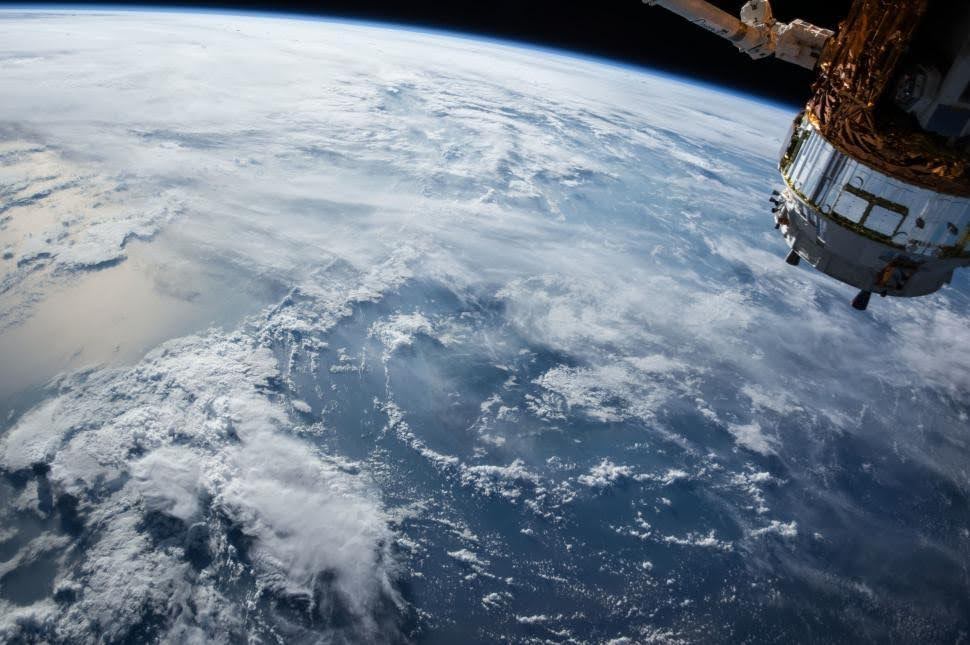





















The Earth’s magnetic field is a protective defense from charged, radiation particles coming from the Sun in outer space. However, the South Atlantic Anomaly (or the SAA) is a weak dip in this magnetic field, allowing for molecules from the Sun to come much closer to the Earth than usual; in fact, this anomaly deepens at 4.3 kilometers (about 14107.6 feet) per year on average, posing a serious concern for low-orbiting satellites/spacecraft and their safety.
Found going through Southern America through parts of the South Atlantic ocean, studies have shown that the dent increasing at such a rate has allowed for the inner radiation belt in the area (which surrounds the Earth’s magnetic field) to go as low as 434-590 kilometers (or 1.4 million to 2 million feet) closer than average from 1900 to 2020. The European Space Agency has also found that the anomaly has grown to about half of the size of Europe since 2014.
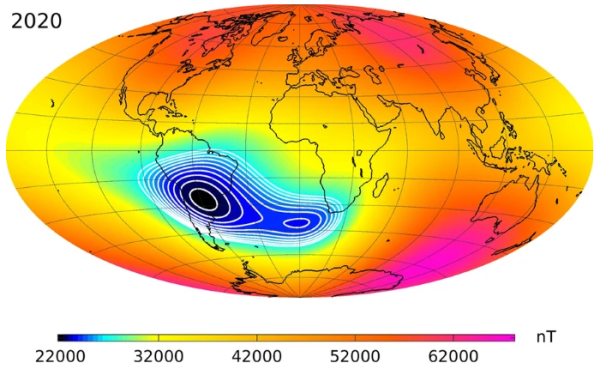
This anomaly can greatly impact spacecraft and satellites. This is because as radiation particles get trapped in the dent, the satellites and spacecraft passing through the SAA come in contact with those particles, leading to mainly system (but possibly more) malfunctions, ultimately leading to data discrepancies and overall spacecraft confusion. Thus, crafts are advised to either turn off their satellites (to stop data transferring to avoid system crashing) when passing through the anomaly or to avoid it entirely, which many crafts such as the Hubble Space Telescope already practice. (Because of these reasons, some have even dubbed the SAA as the “Bermuda Triangle of Space.”)
A situation depicting this was the large loss for Globalstar (a satellite-centered telecommunications company that produces electronics) when numerous first-generation, meaning brand-new, satellites malfunctioned and were lost over time due to coming in contact with the SAA in 2007. This was due to the radiation particles from the Sun encountering the electronic components of the satellite when passing through the anomaly, ultimately leading to the incident.
Theories about other issues with spacecraft relating to the SAA have also arisen; one example is the destroyed Japanese Aerospace Exploration Agency’s “Hitomi” that was launched in 2016 for observation purposes. This craft’s “star tracker” (a component which allowed for it to understand how it appeared in space) had consistently been found dealing with issues when passing through the SAA, and a suggestion was that the radiation particles harming Hitomi’s system caused it to repeatedly attempt to adjust itself to match the incorrect position due to the radiation affecting the star tracker’s sensors. It is theorized that this caused it to continuously rotate until it dismembered entirely.
Thankfully, the SAA poses no current threats to humans on Earth, and the focus largely remains on electronics and satellites and orbiting spacecraft that pass through the SAA. (This is primarily due to the atmosphere’s additional protection against such threats.) Contrarily, concerns have been expressed about astronauts, such as those upon the International Space Station (or this ISS) when they pass through the SAA, as great radiation exposure can lead to the high risk of DNA damage as well as cancer. However, NASA (who is in charge of the ISS) has stated that they utilize instruments to measure and monitor radiation levels, prioritizing astronaut wellness and safety. The anomaly was also theorized to have effect on aircrafts traveling at higher altitudes; however, little to no evidence proved such a theory and it was later debunked by scientific research and studies as untrue.
While human life is largely safe, the anomaly continues to spread; NASA studies have found that the SAA continues to grow westward and also see it dividing into two lobes of weakened intensity, leading to now two zones that satellites must be aware of and monitor. As the anomaly is irreversible, research is still continuing to this day to reduce its impacts.
Sources:
https://www.sciencedirect.com/science/article/abs/pii/S0273117721008905
https://www.astronomy.com/space-exploration/the-spacecraft-killing-anomaly-over-the-south-atlantic/
https://www.sciencefocus.com/space/bermuda-triangle-of-space
https://pubmed.ncbi.nlm.nih.gov/37291163/
https://www.nasa.gov/reference/risk-of-radiation-induced-cancers/