



















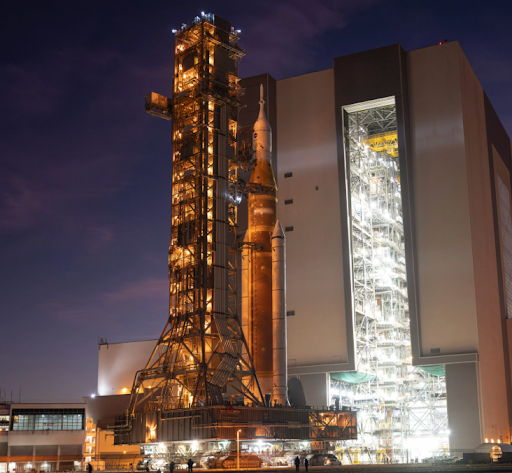























On April 1, NASA launched the Artemis II space mission for a journey around Earth’s celestial neighbor, the moon. While the launch was to validate the functionality of the Orion spacecraft, the trip also broke multiple space-oriented records in the process.
Meet the Crew
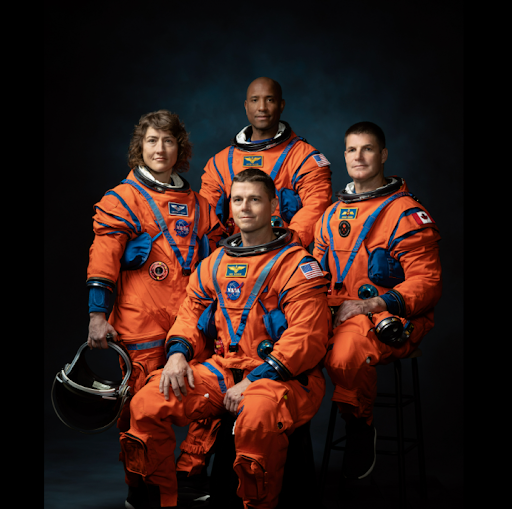
The space crew, including mission specialists Christina Koch and Jeremy Hansel, commander Reid Wiseman, and pilot Victor Glover.
The Artemis II crew consisted of four members, already breaking a record by exceeding the three-member limit enabled for space missions within a single rocket. The identified space crew members were Commander Reid Wiseman, Pilot Victor Glover, and Mission Specialists Jeremy Hansen and Christina Koch, all of whom broke world records individually.
Victor Glover is now the first African-American to pilot a spacecraft and orbit around the moon. Furthermore, Reid Wiseman became one of the oldest individuals to orbit around the moon (and play a part in such a significant space mission).
The two mission specialists also broke their own world records, with Jeremy Hansen now being the first non-American citizen to orbit around the moon. Christina Koch also set one of the most significant world records: being the first woman to go below the Earth’s orbit and around the moon. Koch serves as a major inspiration to all young women aspiring to become astronauts one day, showing that women and men are physically and intellectually equal in every career. Finally, all crew members also went on the longest human space mission ever recorded in history.
The Mission
The space mission, organized by thousands of NASA members, recruited four astronauts to blast off into space. This was done to test if the life-support systems and the Orion spacecraft were reliable and safe enough to carry humans through deep space for future exploration missions.
On April 1, 2026, the mission commenced with a blast-off occurring at the Kennedy Space Center at exactly 6:35 pm EDT. The spacecraft’s twin rockets provided over 75 percent of the needed power to get the engines roaring and the 5.75 million-pound spacecraft soaring. Within 56 seconds, the rocket was going at a supersonic speed, and within two short minutes into the mission, the spacecraft’s flight was verified as stable, and the rockets were detached.
Within the first three days, the spacecraft entered a high-earth orbit, testing the life support and mechanical systems of the spacecraft to ensure they are working properly, and then later traversed deeper into the solar system, validating its maneuverability. The crew then entered the Van Allen radiation belts and tested the Deep Space Network with NASA. At this point, the crew had made it farther than any space mission since 1972’s Apollo 17 and detached their main engine, which released them from Earth’s orbit.

In the midst of the mission (or 3-4 days in), the space mission reached the Deep Space transit phase and continued to test the Orion Crew survival systems. The next day, the crew broke the world record of becoming the farthest human space mission ever, traveling 252,756 miles from the surface of Earth. On the sixth day, the crew performed the free-return trajectory using the moon’s orbit to go around it and start their mission back to Earth. On this day, the crew witnessed an in-space Solar Eclipse where the moon blocked the sun from the Orion’s perspective.
While making the free-return trajectory, Commander Reid Wiseman identified a moon crater and named it after his late wife, Carroll Taylor Wiseman (who unfortunately passed away in 2020 due to cancer), illuminating his eternal relationship with his wife. By the end of this day, the return to Earth began, and the moon began to shrink.
In the last few days of the mission, the crew began its preparations for landing back on Earth. This consisted of housekeeping, preparing the capsule, and working with space centers to ensure a safe landing. On day ten, the crew left the rocket in their capsule, causing the main service module to wash up on the shore of the Pacific Ocean. The crew themselves landed off the Pacific Coast of San Diego on April 10, 2026, at approximately 8:07 EDT, marking the mission as successful.
Reflection
Overall, the space mission was considered flawless and exceeded the targeted expectations set by NASA. Furthermore, the crew members returned to Earth healthy and were able to walk across the boardwalk stably, where they were collected afterwards.
After traversing the celestial world surrounding the earth, Koch provides this perspective of how humans are alike and serve as a united crew:
“A crew is inescapably, beautifully, dutifully linked. Planet Earth, you are a crew.”
Furthermore, when orbiting the moon, Glover stated, “From up here you look like one single thing. We are all Homo sapiens, no matter where you come from or how you look. We are one single people,” creating a sense of unity within all human beings.
This mission has created surges of excitement throughout the world as well. When a CNN reporter was covering Artemis II, he asked 11-year-old Hilt Boling why he was present at the launch. Boling responded with, “We’re going back to the freaking moon, that’s why!”
However, this is only one example. Social media has been swamped with thousands of videos and comments illuminating their support for the four astronauts and all other experts who assisted in making the journey possible and successful.
As NASA is now aware that the Orion spacecraft is successful in supporting humans in long-distance space travel, Artemis III is under construction with plans to bring the diverse crew onto the surface of the moon instead. This Artemis III mission is targeted to be launched in the midst of 2027, ultimately expanding the developing human understanding of the complex universe.
Sources:
https://www.nasa.gov/news-release/nasa-welcomes-record-setting-artemis-ii-moonfarers-back-to-earth/