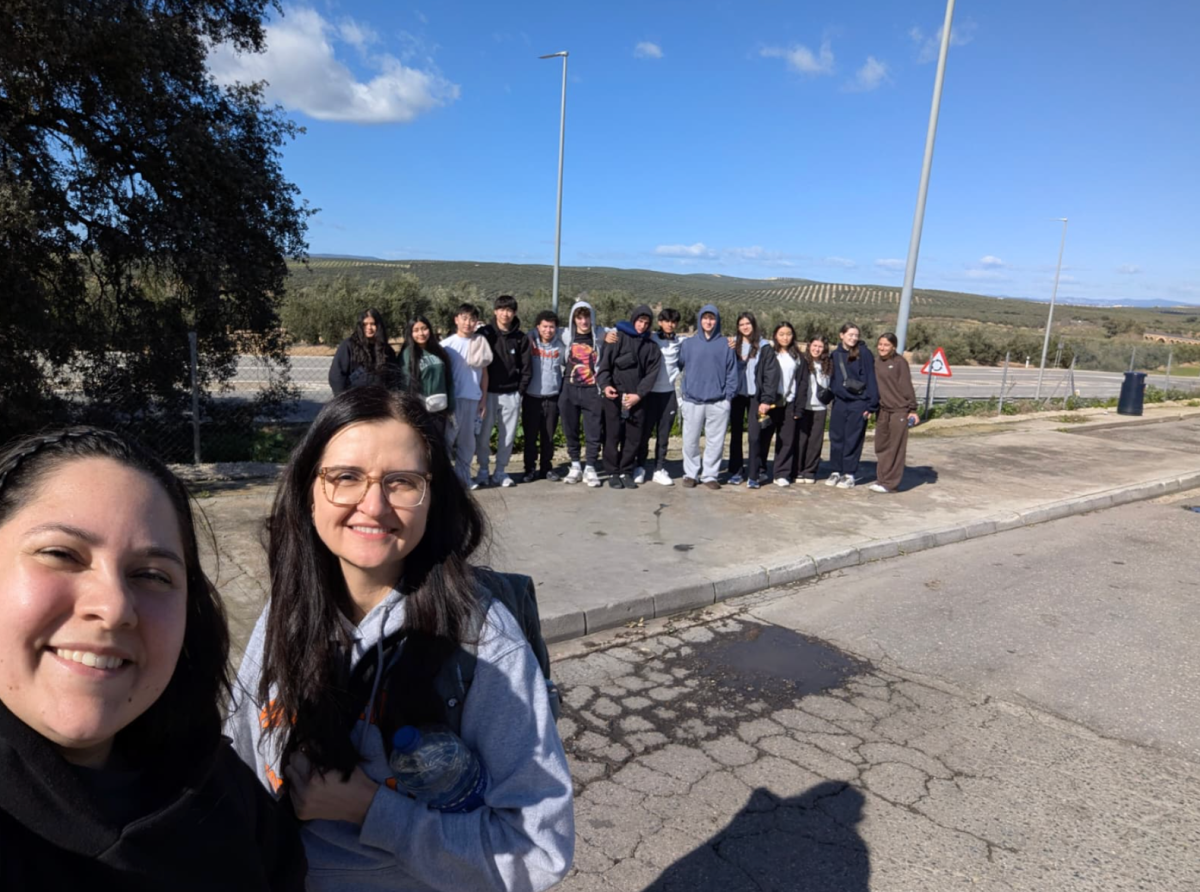





























On Feb. 13, 14 motivated Spanish students from grades nine through 11 departed from Pascack Hills High School for an unforgettable destination: Benalmádena, Málaga, Spain. The now tight-knit group had the opportunity to encounter many unique cultural experiences while abroad.
“For students, I think this trip brought them out of their comfort zone,” Spanish teacher Vanessa Lanchipa-Martinez said. “It showed that traveling can expose people to all different types of cultures when a mutual language is shared.”
Day 0: Travel
On Friday, Feb. 13, after a day of school, students and parents arrived at the PHHS cafeteria at 3:50 p.m. Parents said bittersweet goodbyes while assisting with luggage. The group of 14 students arrived at Newark Liberty International Airport at 6:45 p.m. They boarded the plane and departed for Madrid at around 7:45 p.m.
Even on the plane, the cultural experience was already immense. Students and professors were heard practicing their Spanish in various conversations with Spanish natives and foreigners. During the six-hour plane ride, students were able to meet individuals from all over the world.
Day 1: Travel
After a long flight, students arrived at the Madrid airport around 7:30 a.m. local time on Saturday, Feb. 14. The group was excited to experience their first taste of pure Spanish sunshine, a pleasant surprise to all.
“The weather was so much nicer than Jersey. We could physically feel such a strong sun on our faces. However, the Spanish were surprised when we explained the extent of the New Jersey winter. They were surprised that their winter weather was perceived as warm to us,” junior Rachael Argueta explained.
Due to extreme rains, the rail lines going from Madrid to the final destination of Málaga were shut down. The group ended up taking a five-hour bus ride to get to the Hotel Bali. For the rest of the day, students had down time to relax.
Day 2: Excursion to Córdoba
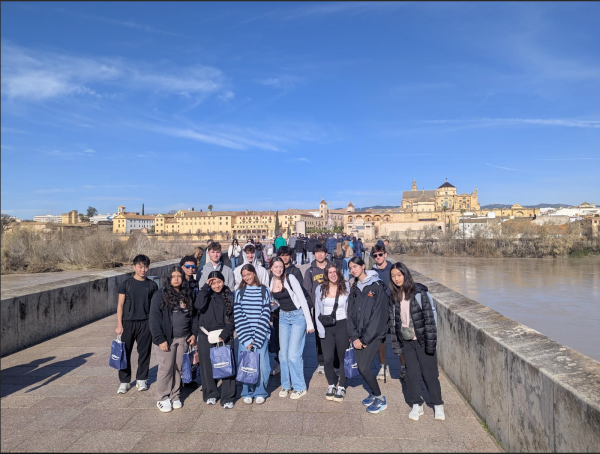
Group on famous bridge in Córdoba
On Sunday, Feb. 15, the well-rested group traveled to Córdoba, Andalusia. Córdoba is a city in the southern region of Andalusia, Spain. The city is rich in ancient Roman as well as Islamic culture.
In Córdoba, students were taught about the Muslim and Roman influence prior to the reconquest of the area by Queen Isabella and King Ferdinand in 1478. This royal family caused the Spanish Inquisition: the forced removal and conversion of Spanish Jews and Muslims.
In Córdoba, students visited the Jewish Quarter, the statue of Maimonides, a Jewish synagogue, a cultural Cordoban courtyard, the Guadalquivir River, and the Mezquita-Catedral de Córdoba: an original mosque converted into a cathedral after the reconquest of the area. At each destination, students were able to learn about the multitude of cultures that impacted the unique atmosphere of the city.
Day 3: School, an olive oil factory, and a Juanito orange farm
The Maravillas School
In the morning, the students experienced their first day at the Maravillas School. During the trip, students studied at the Maravillas School, a linguistic and cultural institution. Students had classes every morning conducted entirely in Spanish on grammar and Spanish culture.
“Our teacher, Pía, embraced our different abilities of speaking Spanish,” sophomore Sophia Kelly said. “She made Maravillas a welcoming environment for all. We were ‘loud Americans’ so we got a lot of ‘Madre Mias’ from her.”
Despite being a native speaker and rigorous professor, Pía made sure her lessons were captivating and enjoyable. She created inside jokes with the teenagers and spoke slowly and clearly. Through the Maravillas School, students were able to improve their vocabulary and grammar knowledge.
Olive Oil Factory and Orange Farm
After a morning of classes, the students ventured out of the city. Their first destination was an olive oil factory. Olive oil — aceite de oliva in Spanish — is one of the main exports of Spain. At the factory, students learned about the different types of olives and how the oil is produced, both now and in the past. At the end, students were able to try different varieties produced in the plant.
At the orange farm, students were able to taste many different varieties of lemons and oranges. The main and most popular product of the farm was the Juanito orange — an incredibly juicy and delicious variety of orange grown in Spain.
“Usually citrus fruits make our mouths really itchy. These oranges didn’t do that. It put into perspective how fresh and natural the food was in Spain,” agreed Kelly and fellow sophomore Laney Mulholland.
Throughout the trip, students were able to taste the Mediterranean diet, a healthy and fresh lifestyle local to Spain.
Day 4: Excursion to Granada
On Tuesday, Feb. 17, the students joined a group of French students on a trip to Granada. The city of Granada is located at the foothills of the Sierra Nevada mountains and is known for its medieval architecture.
In Granada, students visited the Alhambra, a sprawling hilltop fortress encompassing royal palaces, gardens, patios, pools, and fountains. At the site, in addition to the views, students learned about Muslim architecture and the four main materials used — ceramic, wood, plaster, and marble.
“The overall day in Granada was great because we saw sights as well as had time to explore the city by ourselves with friends. I am very grateful to Sra. Kanova and Sra. Lanchipa for letting us have that experience,” sophomore Shoya Maenosono said.
A group of French students from a suburb of Paris were also studying abroad with the Maravillas School. The two international groups combined on the tour to Córdoba for what the professors called a convivencia — coexistence — experience.
“When talking with the French, I noticed that the French people spoke much more English than we realized. It surprised me that they knew three languages while we only knew two. It was great to get to know their culture and perspectives,” sophomore Elyas Bhana said.
Day 5: Snack exchange and Ronda visit
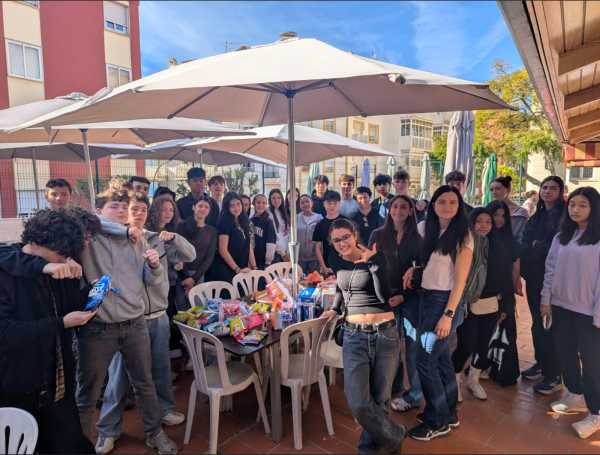
Snack exchange with French friends
On Wednesday, Feb. 18, the students from France and the U.S. combined to exchange cultural snacks. Students from France traded snacks like dried meats, assorted cookies, and chocolate-covered nuts; students from America traded snacks like gummies, Hershey’s Kisses, Reese’s Peanut Butter Cups, Chips Ahoy!, and a group favorite — Tru Fru.
“The snack exchange was interesting. American food had so much color compared to the more natural-looking French food. The French had a lot less processed foods. It showed how different our snacks are, but it was nice to try a different culture’s snacks,” sophomore Rachael Argueta said.
In the afternoon, the group traveled to Ronda. The city was colder but offered amazing views. Students visited the ancient Muslim bath house the city is famous for. The Arab Baths (Baños Árabes) are considered among the best-preserved ancient Muslim thermal baths in the entire Iberian Peninsula. The baths are believed to have been built between the 13th and 14th centuries.
Day 6: School and boat ride
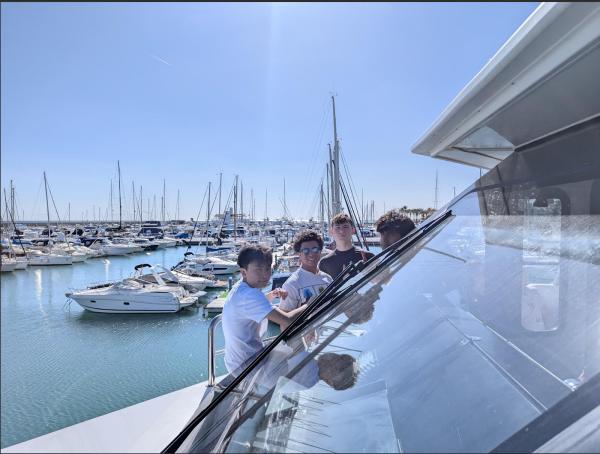
Boat ride out of Benalmádena
The penultimate day of the school studies was Thursday, Feb. 19. Students started off the day once again learning in the school. By this time, the students were already comfortable using many different grammar types and expressing complex ideas in Spanish.
After classes finished, students walked to the ocean for a sightseeing boat ride.
Day 7: School and beach
The final day of school commenced with students playing review games and receiving their graduation certificates. Students were thrilled to have a certificate from the Maravillas School stating they excelled in Spanish.
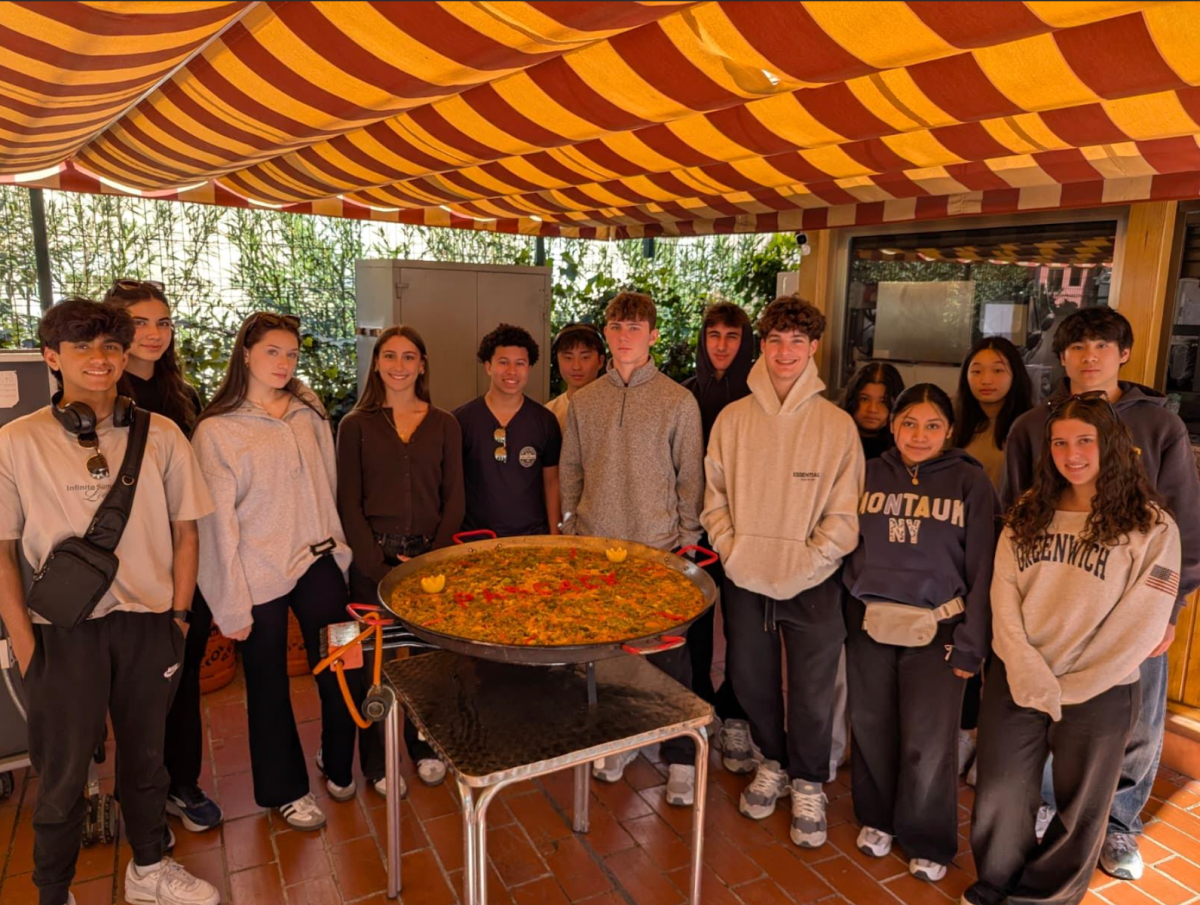
For lunch, the students participated in a cooking class. They learned how to make the traditional Spanish dish paella — a meal consisting of rice, vegetables, seafood, and meat.
In the afternoon, the students went to the beach with a group of children from both Spain and Portugal. During free time orchestrated by the school, the American and Portuguese children played games like volleyball. The experience allowed three different cultures to come together through the shared language of Spanish.
“It was a meaningful experience for the students to be immersed in culture beyond just the basics of learning Spanish,” Spanish teacher Ivica Kanova said, “by them being able to cook the traditional Spanish food and interacting personally with children of their age from the area.”
Day 8: Frigiliana and Málaga
On Saturday, Feb. 21, the students checked out of the hotel and traveled by train to see Frigiliana and Málaga.
In Frigiliana, the students found magnificent views of the decorated white ceramic houses — las casas blancas.
In Málaga, the students toured the Alcazaba, a fortification complex built by Muslims prior to the Spanish Inquisition. The fort was built in the 11th century, though modifications continued until the 14th century.
At the end of the day, students traveled to Madrid where they would board their flight the following day.
Day 9: Departure
To everyone’s disappointment, the trip finally concluded with the group departing from the Madrid airport at 11:45 a.m. local time. The group was lucky enough to not experience any complications with the heavy blizzard approaching in the U.S.
“I am really sad we will be leaving soon. I wish we could still stay here,” freshman Kayla Lema said.
Importance of mixing cultures
Although traveling to a different country was difficult, the trip was worth the effort for every student. The benefits of traveling abroad include experiencing a new culture, practicing a foreign language with locals, seeing monuments in person, and gaining a sense of independence.
While students can learn facts through reading textbooks in class, it is not the same. By physically traveling, students are taken out of their comfort zone. In the classroom, it isn’t possible to touch the 1,000-year-old stone of an ancient mosque or immerse oneself in a conversation with a local inhabitant.
“We helped the students realize that it isn’t difficult to travel. A student doesn’t need to wait for college to learn abroad,” Kanova said. “The sooner a student immerses themself within a culture, the better it is for them.”
“Everyone is in agreement. This trip was so awesome,” sophomore Shoya Maenosono said.